
Short answer
Your garage door is almost certainly the weakest point in your home's exterior wall. It's the largest moving opening in the structure, held in place by springs, rollers, and a track system instead of continuous framing. When wind pressure builds against it during a fall storm, a door that isn't properly braced, balanced, or sealed can buckle, pop off its track, or blow in entirely — and once that happens, wind gets inside the structure and can push up on the roof from underneath. The fix isn't complicated: tighten the hardware, check the balance, reinforce what needs reinforcing, and do it before the next storm system rolls through, not after.
Why the garage door takes the hit first
A standard exterior wall is a continuous assembly of studs, sheathing, and siding working together. A garage door is a large panel of steel or aluminum held in a track by rollers, hinges, and a counterbalance spring system. It's engineered to move up and down smoothly, not to resist lateral wind load the way a solid wall does. Add in age, worn rollers, a stretched or rusted track, or hardware that's never been tightened, and that panel has even less resistance to push back against sustained gusts or a sudden pressure change.
This matters more here than in milder climates. Northern Illinois gets genuine wind events in the fall shoulder season as cold fronts move through ahead of winter, on top of the swings between humid late-summer afternoons and the first hard freezes. That freeze-thaw cycling loosens fasteners, stiffens or cracks weatherstripping, and shrinks wood jambs, all of which quietly reduce how much wind load a door can actually handle by the time a real storm shows up.
What to check before the next windy stretch
- Track alignment: Stand back and look down the length of each track. Gaps, bends, or spots where it's pulled away from the wall bracket are structural weak points — a door can jump track under wind load at exactly those spots.
- Rollers and hinges: Cracked or badly worn rollers let the panel wobble side to side instead of riding true. Worn hinges allow panel sections to flex against each other, which is how buckling starts.
- Fasteners: Track brackets, hinge bolts, and the bracket holding the bottom roller bracket all loosen over time with vibration and temperature swings. A socket wrench and twenty minutes catches most of this.
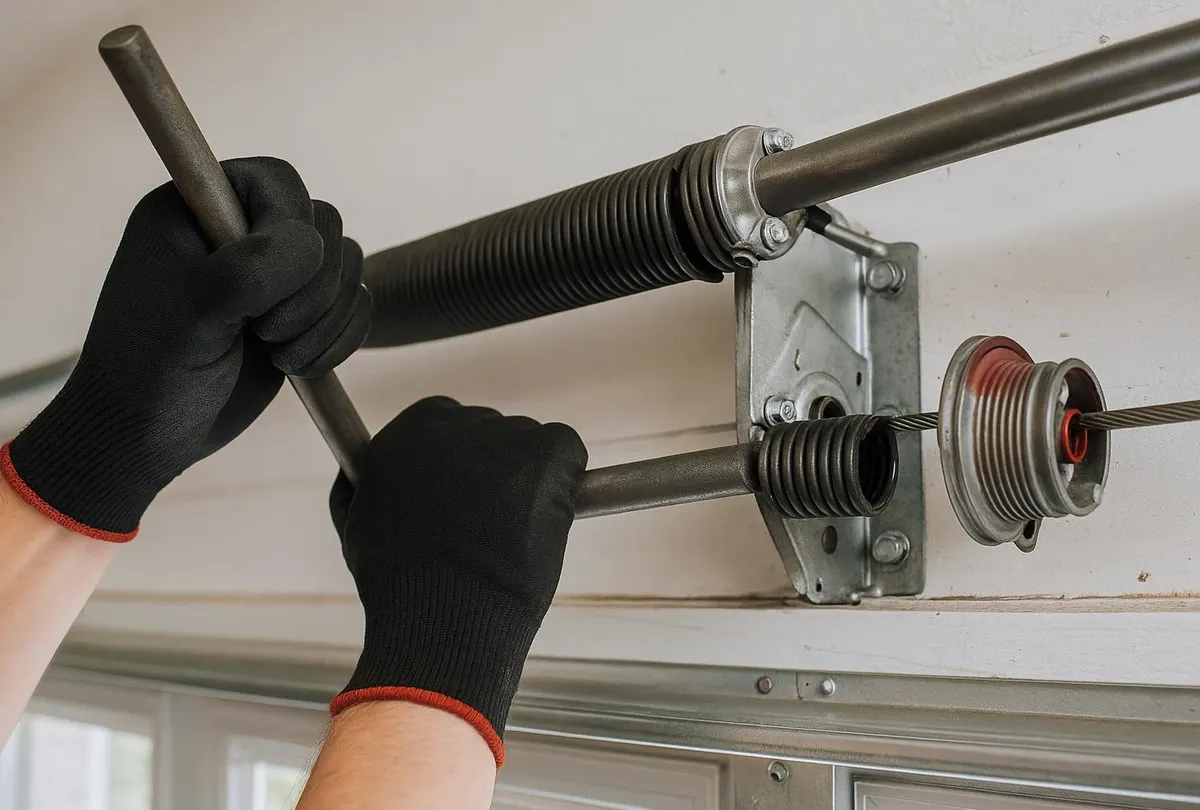
- Spring tension and balance: Disconnect the opener and lift the door halfway by hand. It should hold its position. If it drifts up or crashes down, the springs are out of balance and the opener is doing work it shouldn't have to — which also means less reserve capacity if wind adds load to the equation.
- Weatherstripping and bottom seal: Cracked, flattened, or torn seals let wind-driven water in and give gusts a place to grab the bottom edge of the panel. This is also your main defense against ice and salt spray tracking into the garage all winter.
- Panel condition: Dents, especially ones that have flexed a panel's seam, reduce the door's ability to flex back under pressure without failing. Minor dents are often fine; seam damage usually isn't.
If your door doesn't have wind bracing
Many standard residential doors, especially older ones, were never built with reinforced struts across the back of the panels. Horizontal bracing kits add real rigidity against lateral wind pressure and are a reasonable upgrade if your area has seen fall or spring wind events strong enough to concern you. This is a trade-off worth discussing rather than guessing at: bracing adds stiffness but won't fix an already-failing track or worn rollers, so it works best as part of a full inspection rather than a standalone fix.
Don't ignore the opener and the automatic reverse
Before storm season, test the auto-reverse safety feature: place a block of wood in the door's path and close it. It should stop and reverse on contact. A door that doesn't reverse properly is also one where the force settings may be miscalibrated — which matters both for safety and for how the door responds to wind pressure while moving.
When to call Palatine Garage Door
If your door is out of balance, the track shows gaps or bends, rollers are cracked, or you just want a professional once-over before the windy months hit, that's the time to call. Our garage door maintenance visits cover track alignment, hardware tightening, spring balance, and weatherstripping, and we handle spring repair and replacement on the spot when a door's counterbalance is the real problem. If something's already failed — a door off its track, a snapped spring, a panel that won't move — our emergency garage door service gets a technician out to secure the door and get it operating safely again.
Get ahead of the next storm system instead of reacting to it. Call Palatine Garage Door for a pre-season inspection, or reach out any time you need a Palatine, IL garage door technician you can count on.